
 Instagram
 Google
 Tec de Monterrey
POLÍTICA DE PRESERVACIÓN DIGITAL
Datos de investigación
Disponibilidad de datos de investigación
Atendiendo al nivel de cumplimiento que la Revista Virtualis declara en sus Políticas de las Directrices TOP, adaptadas por Scielo, los autores deberán considerar los siguientes requerimientos en relación a la referencia y acceso a los datos, códigos y materiales utilizados en la investigación:
Criterios requeridos
- Citas.
- Los datos, códigos y materiales que subyacen al artículo y utilizados en la concepción y realización de la investigación deben ser citados adecuadamente en el texto e incluidos en la lista de referencias, preferiblemente con un identificador persistente como el DOI.
- [Ejemplo: García, Francisco & Gertrudix, Manuel (2018). Producción de información y participación ciudadana basada en datos abiertos. e-cienciaDatos, V3 [dataset], https://doi.org/10.21950/8MCALL]
- Transparencia de los datos.
- Todos los artículos resultantes de investigaciones originales deben enviarse con una sección llamada "Disponibilidad de datos" y el conjunto de datos se debe depositar en un repositorio confiable.
- Si el artículo es aceptado para publicación, la "Disponibilidad de datos"será publicada en el artículo final.
- Se recomienda la publicación en repositorios abiertos de datos genéricos como Zenodo, fighshareo Mendeley Data, especializados en Ciencias Sociales como Harvard Dataverse, Open ICPSR, Open Science Framework, Qualitative Data Repository, o iniciativas regionales vinculadas a su institución como, por ejemplo, eCiencia Datos
- [Textos de ejemplo para incluir en el apartado "Disponibilidad de datos", según corresponda: Opción 1: Todo el conjunto de datos que apoya los resultados de este estudio fue publicado en el [nombre del repositorio] y puede ser accedido en [URL o DOI]. Opción 2: Todo el conjunto de datos que apoya los resultados de este estudio fue publicado en el [nombre del repositorio] con los identificadores [lista de identificadores]. Opción 3: Todo el conjunto de datos anónimos que apoya los resultados de este estudio fue publicado en el [nombre del repositorio] y puede ser accedido en [URL o DOI].]
- En el caso de que haya restriccionesal compartir los datos por razones éticas o legales, deben ser informadas en el momento de la presentación del artículo.
- [Texto de ejemplo para incluir en el apartado "Disponibilidad de datos" si hay restricciones a su publicación: Todo el conjunto de datos que apoya los resultados de este estudio está disponible mediante solicitud al autor de contacto [nombre del autor de contacto]. El conjunto de datos no está públicamente disponible debido a [detalle motivo de restricción, por ejemplo, contener información que compromete la privacidad de los participantes de la investigación]
- Transparencia de los métodos analíticos y de los materiales de investigación.
- Se recomienda que antes de realizar el envío, los autores verifiquen si su artículo sigue los estándares o referencias metodológicas adecuados al objeto de la investigación o tipo de estudio para divulgar aspectos claves del diseño de investigación y análisis de datos.
- Se recomienda que el checklist/formulario utilizado sea enviado junto con el artículo en la presentación como documento de apoyo.
- [Ejemplo: Chitu Okoli. A Guide to Conducting a Standalone Systematic Literature Review. Communications of the Association for Information Systems, 2015, 37. ffhal-01574600f]
- Transparencia del diseño y análisis.
- Durante el envío, los autores deben informar si existe preregistro del estudio y/o preregistro del plan de análisis y dónde acceder a él.
- El preregistro de estudios implica el registro del diseño del estudio, variables y condiciones de tratamiento, y la inclusión de un plan de análisis implica la especificación de la secuencia de análisis o el modelo estadístico que será reportado, de forma que el preregistro del plan de análisis sustituye el preregistro de estudio y destaca la distinción entre investigación confirmatoria e investigación exploratoria.
- Replicación.
- Tal como establece el Center for Open Sciencelos estándares de transparencia que se suscriben Wrepresentan la reproducibilidad de los resultados informados en función de los datos de origen y para compartir información suficiente para realizar una replicación independiente", es decir que facilitan que se puedan replicar o reproducir los estudios previos realizados usando los mismos materiales.
- La Revista Virtualis alienta la presentación de estudios de replicación, principalmente de estudios publicados en esta revista.
- Los autores que remitan estudios de replicación deberán seguir las indicaciones indicadas para dicha sección en el apartado "Acerca de"de la Revista.
Política de disponibilidad de datos de la investigación
La Revista Virtualis suscribe las Directrices para la transparencia y promoción de la apertura (Directrices TOP) con la finalidad de contribuir a la transparencia y apertura de las investigaciones, tanto en sus procesos como en sus contenidos.
El objetivo de estas Directrices TOP es facilitar que la disponibilidad y citación adecuada de los materiales anexos a los artículos publicados, y que han formado parte de su desarrollo, permita:
- La evaluación, validación y reproducibilidad de las investigaciones.
- Reutilizar los datos, códigos y materiales recogidos y utilizados en el diseño, la realización y la comunicación de las investigaciones publicadas.
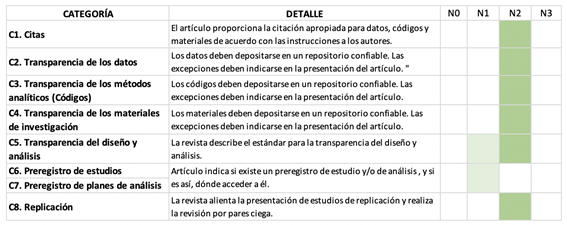
El cumplimiento de estas Directrices requiere que los artículos publicados en la Revista Virtualis deberán indicar y citar la disponibilidad de todos los materiales y recursos de base que hayan sido utilizados para el desarrollo de la investigación y los resultados obtenidos, tal como se detalla en las normas de publicación.
En este gráfico se muestra el actual nivel de cumplimiento de las directrices TOP que realiza la revista Virtualis.
Principios FAIR
La Revista Virtualis subscribe los Principios FAIR (Findability, Accessibility, Interoperability, and Reusability) en la publicación de los datos de investigación. Para su correcta aplicación, se recomienda el uso de la aplicación FAIR-Aware.
Política de Crossmark de la Revista Virtualis
Todos los artículos publicados en la Revista Virtualis son asignados con un DOI (Digital Object Identifier) y quedan permanentemente disponibles en la versión final que ha sido evaluada por el sistema de doble ciego.
Para que los lectores puedan acceder a la última versión del artículo y conocer, si este ha sido actualizado, cuál ha sido el historial de los cambios, correcciones o retractaciones, cada artículo incluye el botón "Crossmark".

La Revista Virtualis se compromete a llevar a cabo el mantenimiento del contenido que publica, a registrar las modificaciones o actualizaciones que pudieran producirse en el mismo de forma inmediata, y a hacer visible el botón Crossmark en las diferentes versiones que pudiera publicar de los artículos.
Siguiendo las recomendaciones de buenas prácticas de publicación científica y bibliográficas de COPE (Comité de Ética de Publicaciones), la política de cambios se ajustará a las siguientes circunstancias:
Corrección de un artículo
Las correcciones se ajustarán a erratas importantes descubiertas después de la publicación y que puedan inducir a error a los lectores.
Retracción
Los artículos podrán ser retractados por alguna de las siguientes razones:
- Errores no deliberados reportados por los autores/as (por ejemplo, en los datos, en los instrumentos o en los análisis utilizados).
- Incumplimiento ético (datos fabricados, uso fraudulento de datos, plagio, investigación no ética, duplicidad de publicación o solapamiento, falsificación o manipulación de imágenes.
Para cualquier artículo retractado se indicará la causa y quién ha solicitado esta en la Nota de retracción que se publicará junto al artículo retractado que aparecerá en el sitio con una marca de agua que indique claramente que ha sido retractado.
Podrán solicitar la retracción de un artículo los autores/as, cuando se haya producido un error no deliberado, y cualquier institución o investigador que detecte alguna de las causas contempladas en el código ético suscrito por la Revista Virtualis.
El procedimiento de retractación seguirá las normas recomendadas en la Guía de COPE (Comité de Ética de Publicaciones).
Nota editorial
En el caso de que se produzca un problema con un artículo, y hasta que la investigación sobre el mismo se resuelva, se publicará una nota editorial para alertar a los lectores de que dicho artículo está sujeto a este proceso de revisión.
¿Qué es Crossmark?
Crossmark es un servicio de Crossref que permite conocer, por parte de los lectores, si los textos publicados en la revista han sufrido alguna modificación, retractación o actualización posterior a su publicación.
El objetivo es facilitar a los lectores una forma sencilla de reconocer que están leyendo la última versión del documento y si este, con posterioridad a su publicación, ha sufrido alguna modificación.
Política de autoarchivo
La revista Virtualis permite e invita a sus autores/as a ampliar la visibilidad, alcance e impacto de sus artículos publicados en la revista mediante la redifusión (auto-archivo) de los mismos en:
- Sus espacios web personales (web, blog, redes sociales, foros científicos, etc.).
- Archivos abiertos institucionales (archivos universitarios, Hispana, Europeana...).
- Redes sociales de naturaleza académica y científica (ResearchGate, Academia.edu, Getcited.org).
Se requiere que en dichas publicaciones se detallen todos los datos bibliográficos de la publicación y siempre que se pueda se distribuya el artículo en formato pdf.
Políticas de privacidad y cookies
Datos de identificación
Los datos recopilados de los usuarios registrados y no registrados de la revista Virtualis entran dentro del alcance del funcionamiento estándar de las revistas revisadas por pares.
El equipo editorial de esta revista utiliza esta información para guiar el trabajo de publicación y mejora de esta revista. Los autores/as cuyos trabajos se publican en esta revista son los/las responsables de los datos sobre personas que puedan contener o aparecer en las investigaciones publicadas.
Los editores/as de la revista Virtualis cumplen con los estándares industriales de privacidad de datos, de forma específica la disposición de la Regulación General de Protección de Datos Personales para "derechos de los sujetos de los datos" así como por la Ley Federal de Protección de Datos Personales en Posesión de los Particulares. , que incluyen (a) notificación de incumplimiento; (b) derecho de acceso; (c) el derecho a ser olvidado; (d) portabilidad de datos; y (e) privacidad por diseño. El GDPR también permite el reconocimiento del "interés público en la disponibilidad de los datos", que tiene una especial relevancia para aquellos involucrados/as en mantener, con la mayor integridad posible, el registro público de publicaciones académicas.
¿Quién es el/la responsable de los datos?
- Denominación Social: Asociación Científica Virtualis
- Nombre Comercial: Virtualis
- Domicilio Social: Virtualis
- ID, INE, CIF / NIF:
- Teléfono:
- Contacto:
- Inscrita en el Registro:
- Nombre de dominio:
- Autorización administrativa:
¿Qué información recogemos y con qué finalidad tratamos sus datos?
- Enviar comunicaciones sobre el proceso editorial.
- Guiar a los autores/as sobre el trabajo de publicación y mejora de esta revista.
- Informar a los lectores sobre la autoría y edición de contenido.
- Mejorar la recuperación de información y de los artículos de interés por parte de los lectores a través de la recopilación de datos agregados sobre el comportamiento de los lectores y el rastreo de elementos de la comunicación académica.
- Gestionar la correspondencia editorial.
- Enviar información y comunicaciones informativas relacionadas con la investigación científica de las áreas de interés y el foco de la revista, a través de distintos medios, entre ellos el boletín de noticias de la revista, gestionado mediante la aplicación externa Mailchimp.
- Realizar estudios estadísticos relacionados con las áreas de interés y el foco de la revista.
- En el caso de los autores/as que publican en la revista, para el abono de las tarifas de maquetación de los artículos, dicho pago se realizará a través de Paypal mediante la pasarela de pago habilitada en Open Journal Systems (OJS) que le redirigirá a aquella. Para la emisión de la factura le solicitaremos los datos de facturación correspondientes: Nombre de la persona o entidad, dirección fiscal completa, NIF/CIF/NIE.
- No tomamos decisiones automatizadas con base en sus perfiles.
- Recibimos información a través de otras plataformas como, por ejemplo, el registro a través de ORCID o tecnologías similares. Esto podría incluir texto o imágenes personales disponibles en la página externa.
¿Durante cuánto tiempo conservamos sus datos?
Los datos personales proporcionados se conservarán bloqueados al finalizar la relación y la supresión se efectuará de conformidad con lo establecido en las normas y reglamentos mexicanos, es decir 72 meses a partir del término de dicha relación.
No obstante, dado que en la publicación académica, los datos relativos a los/las autores/as, editores/as, revisores/as y otros involucrados en el proceso editorial siguen siendo necesarios para los fines de la revista, "para archivo con fines de interés público, investigación científica o histórica o con fines estadísticos cuyo mantenimiento sea de interés público".
¿Cuál es la legitimación para el tratamiento de sus datos?
La base legal para el tratamiento de sus datos es la prestación del servicio y/o consentimiento del interesado, de conformidad con lo establecido por la Ley Federal de Protección de Datos Personales en Posesión de los Particulares.
Para el envío de los boletines de novedades, a través del correo electrónico que nos ha sido proporcionado, o para reconocerle en su próxima visita, nos basamos en el consentimiento informado.
El tratamiento de la información que recogen nuestras cookies está basado en el consentimiento informado, el cual nos brinda de conformidad con la legislación vigente.
¿A qué destinatarios se comunicarán sus datos?
Los datos que ayudan al desarrollo de la plataforma de publicación Open Journal System que utiliza la revista Virtualis podrán compartirse con su desarrollador Public Knowledge Project en forma anónima y agregada, con las excepciones apropiadas, como las métricas de artículos.
Los metadatos personales vinculados con la publicación de un artículo (nombre y apellidos de los autores, filiación profesional, número ORCID, país) son depositados y distribuidos, asociados a los del artículo, para la asignación del Digital Object Identifier (DOI) a través de Crossreff. Asimismo, y con las misma finalidades de preservación, difusión y mejora de recuperación científica, se distribuye a través del sistema LOCKSS al archivo distribuido de bibliotecas, así como a otros sistemas de ciencia abierta.
Los datos no serán cedidos o vendidos por esta revista o Public Knowledge Project (PKP) ni se utilizarán para fines distintos a los establecidos expresamente.
¿Existe una obligación de facilitar datos y consecuencias de no hacerlo?
No aportar los datos expresamente solicitados impedirá la inscripción en la revista, el envío de originales y el seguimiento editorial de los mismos.
¿Cómo protegemos tus datos?
La web de la revista Virtualis utiliza técnicas de seguridad de la información generalmente aceptadas en la industria, tales como firewalls, procedimientos de control de acceso y mecanismos criptográficos, todo ello con el objeto de evitar el acceso no autorizado a los datos. Para lograr estos fines, el usuario acepta que el prestador obtenga datos para efectos de la correspondiente autenticación de los controles de acceso. Toda la información es siempre transmitida mediante protocolo de comunicación segura (https, SSL), de tal forma que ningún tercero tenga acceso a la información transmitida vía electrónica.
Todos los datos personales se almacenan de forma segura de acuerdo con el Reglamento general de protección de datos de la UE (Reglamento (UE) 2016/679) (GDPR) y la Ley Federal de Protección de Datos Personales en Posesión de los Particulares.
¿Cuáles son sus derechos cuando nos facilita sus datos?
- Cualquier persona tiene derecho a obtener confirmación sobre si en la Asociación científica Virtualis estamos tratando datos personales que les conciernen, o no.
- Las personas interesadas tienen derecho a acceder a sus datos personales, así como a solicitar la rectificación de los datos inexactos o, en su caso, solicitar su supresión cuando, entre otros motivos, los datos ya no sean necesarios para los fines que fueron recogidos.
- En determinadas circunstancias, los interesados podrán solicitar la limitación del tratamiento de sus datos, en cuyo caso únicamente los conservaremos para el ejercicio o la defensa de reclamaciones.
- En determinadas circunstancias y por motivos relacionados con su situación particular, los interesados podrán oponerse al tratamiento de sus datos. La Asociación científica Virtualis dejará de tratar los datos, salvo por motivos legítimos o el ejercicio o la defensa de posibles reclamaciones.
- A interponer una reclamación ante la Autoridad de Control – Agencia Española de Protección de Datos.
¿Cómo ejercer los derechos de su titularidad?
- En la dirección electrónica:
- Correo electrónico:
- Legislación vigente: Ley Federal de Protección de Datos Personales en Posesión de los Particulares.
- Dirección Postal:
- Derecho a retirar el consentimiento: tiene derecho a retirar el consentimiento prestado.
- Derecho a reclamar ante la Autoridad de Control:
Política de Cookies
La revista Virtualis usa cookies para administrar las sesiones de los usuarios, para lo cual son necesarias si es usted autor/a, revisor/a o editor/a de la revista. No se usan las cookies si únicamente se accede a la revista como lector/a, sin registro.
En algunas páginas utilizamos cookies para recordar cuestiones como: a) sus preferencias de presentación; b) el estado de proceso de un artículo enviado; c) la lectura de las notificaciones relacionadas con el proceso de evaluación y editorial de un artículo; d) si ha dado o no su consentimiento para que utilicemos cookies en nuestra web, ) los accesos de lectura realizados a los artículos publicados.
Además, algunos recursos multimedia, como los videos incrustados en nuestras páginas utilizan cookies para elaborar estadísticas anónimas sobre cómo ha llegado hasta ellos y qué videos ha visualizado.
Aunque las cookies no son imprescindibles para que el sitio web funcione, si las habilita disfrutará de una mejor experiencia de navegación. Puede borrar o bloquear las cookies, pero si lo hace es posible que algunas de las características de esta web no funcionen adecuadamente. Para el acceso al sistema de envío de artículos y seguimiento del proceso editorial estas cookies son imprescindibles, por lo que si no se habilitan no podrá utilizar dicho sistema.
La información asociada a las cookies no se utiliza para identificar personalmente al usuario. Además, mantenemos plenamente bajo nuestro control los datos sobre sus patrones de navegación. Estas cookies se utilizan exclusivamente para los fines aquí indicados.
Análisis de métricas web
Los servidores del sitio web podrán detectar de manera automática la dirección IP y el nombre de dominio utilizados por el usuario. Una dirección IP es un número asignado automáticamente a un ordenador cuando éste se conecta a Internet. Toda esta información es registrada en un fichero de actividad del servidor que permite el posterior procesamiento de los datos con el fin de obtener mediciones únicamente estadísticas que permitan conocer el número de impresiones de páginas, el número de visitas realizadas a los servicios web, el orden de visitas, el punto de acceso, etc.
Para esta finalidad, se utilizan tanto sistemas internos de analítica de OJS como el servicio externo de Google Analytics.